Two condos went under contract in Boca Raton this summer within a few thousand dollars of each other. One sits in a beachfront tower that opened its doors sometime in the late 1980s. The other is a reservation in a still-rising, all-glass building downtown that won't deliver a key until 2027. Both listings would have shown up in the same search, both near the city's roughly $350,000 condo median for August 2026. Only one of those buyers is walking into a legal deadline that has already arrived.
Since January 1, 2026, Florida's post-Surfside condo laws stopped being a future problem for associations to plan around and became a present one they have to fund. In Boca Raton, where most of the condo inventory sits close enough to the water to trigger the earlier version of the state's inspection clock, that shift is doing more to separate one building from another than square footage or view ever did.
The Median Everyone Quotes, and What It's Actually Averaging
The median list price for a Boca Raton condo or co-op was $349,950 in August 2026, down slightly from $359,250 a year earlier. Compare that to the median list price for a single-family house in the same city over the same month, $1,399,000, up from roughly $1.05 million in August 2025, and you start to see how wide a net that condo number is casting.
A $350,000 median has to account for a one-bedroom in a 1980s mid-rise with a decades-old roof and a two-bedroom in a brand-new tower priced from $2.7 million. It also has to account for the fact that, according to the Institute for Luxury Home Marketing's most recent read on the market, days on market for attached homes in Boca Raton edged up to 68 from 64 a year prior, even as the luxury segment's median sale price climbed to $850,000 from $760,000. Buyers are taking longer to decide, and the properties clearing fastest at the top of the market are not the ones with the lowest monthly fee. They're the ones with the cleanest paperwork.
The Rule Boca Can't Really Opt Out Of
Florida's milestone inspection law, tied to Florida Statute 553.899, sets two different clocks depending on where a building sits. Most condominiums three stories or taller get inspected at 30 years. Buildings within three miles of the coastline get inspected five years earlier, at 25, and then every ten years after that.
Boca Raton doesn't get much benefit of the doubt on that distinction. A Boca-based inspection firm that works almost exclusively on local buildings puts it plainly: most of the city's condo inventory falls within that coastal band, and the 25-year rule applies across most of Boca Raton east of I-95. A building that opened its doors in 2001 is already inside the compliance window this year. One from the mid-1990s construction boom the city saw during that era isn't approaching a deadline. It's past one.
The inspections themselves aren't free, and the cost scales with how much building there is to inspect. A Phase 1 milestone inspection for a typical Boca Raton mid-rise runs $3,000 to $8,000. For the larger high-rise properties along the beach, that figure climbs to $10,000 to $20,000 or more, and if the Phase 1 report turns up substantial deterioration, a more invasive Phase 2 investigation adds weeks and dollars on top of that.
What Actually Changed on January 1
The inspection is only half of it. The other half is the Structural Integrity Reserve Study, or SIRS, which every qualifying condo association now has to fund in full. For years, boards kept monthly dues attractive by voting to waive or underfund reserves for exactly this kind of work. That option closed for good this year. Under Florida's rules, associations that adopted a budget on or before December 31, 2024 got one more cycle to phase in funding. Anyone whose budget was adopted after that date lost the ability to waive SIRS reserves entirely, and as of January 1, 2026, full funding became mandatory statewide, according to Florida's Division of Condominiums, Timeshares and Mobile Homes.
The SIRS itself has to account for eight specific structural components: the roof, load-bearing elements, fire protection systems, plumbing, electrical systems, waterproofing, windows and doors, and any other item over $25,000 that affects the building's structural integrity. A study that finds one of those components underfunded doesn't produce a recommendation. It produces a bill, and boards are now covering that bill through some combination of special assessments, lines of credit, and long-term loans rather than the general operating budget.
There's a financing consequence too. A building without a completed SIRS on file can be treated by conventional lenders as non-warrantable, which narrows the pool of buyers who can get a mortgage there down to cash purchasers. That single document, more than the amenities or the view, increasingly determines who can actually buy into a building.
Reading the Two Tiers Side by Side
| Legacy tower (built 1970s to 1990s) | New construction (2024 to 2027 delivery) | |
|---|---|---|
| Milestone inspection | Due at 25 years for most buildings east of I-95, many already past due | Certificate of occupancy is recent, decades before the clock starts |
| SIRS funding | Must be fully funded now, no more waiving | Reserve schedule built into the budget from day one |
| Monthly HOA fee | Often historically low, now catching up fast | Higher from the start, already reflects real cost |
| Financing | Risk of non-warrantable status if SIRS is incomplete | Typically eligible for standard conventional financing |
| Local examples | Most 1980s and 1990s mid-rises east of I-95 | Glass House Boca Raton, the approved 501 E. Camino Real tower |
The New Buildings Are Betting on This Split
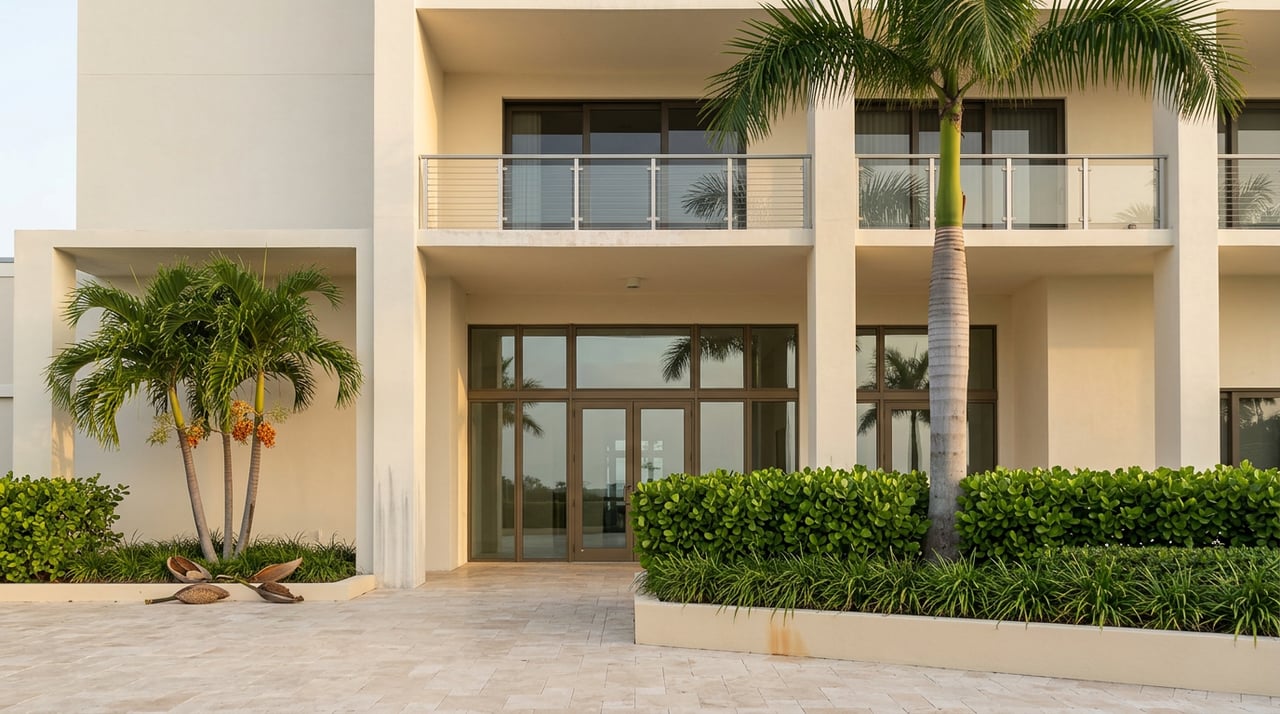
Boca Raton's newest condo projects aren't shy about what they're selling against. Glass House Boca Raton, rising at 280 E. Palmetto Park Road, is being marketed as the city's first modern all-glass high-rise. Its developer secured a $70 million construction loan in March 2026 to push the building, underway since mid-2025, toward a 2027 completion. Units range from 2,500 to 3,864 square feet with two to four bedrooms, priced from $2.7 million, and more than a third of the building had sold as of this spring. None of that price reflects a legacy reserve problem, because there isn't one yet to reflect.
A few miles away, the Boca Raton City Council voted unanimously this spring to approve a 76-unit, eight-story condominium on land carved out of the Boca Raton Resort's own golf course maintenance yard at 501 E. Camino Real. The building, designed by Hart Howerton, will sit on roughly 5.2 acres and include a three-story fitness center, indoor and rooftop pools, and a residents-only club, all attached to a resort that itself underwent a $120 million renovation in 2024. As of that spring vote, it still needed final permits and design work before construction could begin, but it's one more entrant in a wave that also includes Mr. C Residences downtown and recently delivered buildings like Alina Residences, all competing on the same premise: buy new, and the structural funding question is already answered.
What This Means If You're Comparing Two Listings
A low HOA fee used to be a selling point. On an older building in Boca Raton today, it's a question you need answered before it's a reason to make an offer. Before writing one, ask for the SIRS and the date the current budget was adopted. If it's on or after January 1, 2025, the association is legally required to be funding structural reserves in full, which should show up in the numbers. If it's earlier, ask directly how the board is closing the gap during this final phase-in year.
Ask, too, whether the building has completed its milestone inspection, especially if it's east of I-95 and anywhere near 25 years old. And ask a lender, plainly, whether the building currently qualifies for conventional financing or whether it's being treated as non-warrantable. That single answer can eliminate half your buyer pool later if you're the one selling.
None of this means the older buildings are a bad bet. Many have already done the work, and a fully funded reserve on a 1985 tower can be a better sign than a brand-new building's marketing brochure. The point is that the $349,950 median doesn't tell you which one you're looking at. Only the paperwork does.
A Few Questions Buyers Keep Asking
If my building isn't right on the beach, does the 25-year rule still apply? Possibly. The trigger is proximity to the coastline, not oceanfront status, and in Boca Raton that band covers most of the city east of I-95, including buildings on the Intracoastal or set back from the water.
Does a completed milestone inspection mean the SIRS funding question is settled? No. The inspection identifies structural condition. The SIRS translates that condition into a funding schedule. A building can pass its inspection and still be behind on reserves for the repairs the inspection recommends.
What happens if my association hasn't completed its SIRS yet? It's now out of compliance with state law, which can affect insurance, financing for buyers, and the board's own liability. Ask when it's scheduled and request the timeline in writing before you go under contract.
Boca Raton's condo market didn't get simpler this year. It got more legible, provided you know which document to ask for. If you're weighing a purchase in one of the city's older towers or trying to figure out what a new building's price actually buys you, Irene Siconolfi has spent 25 years reading exactly this kind of paperwork on the South Shore and across South Florida. Work With Irene before you write the offer, not after.